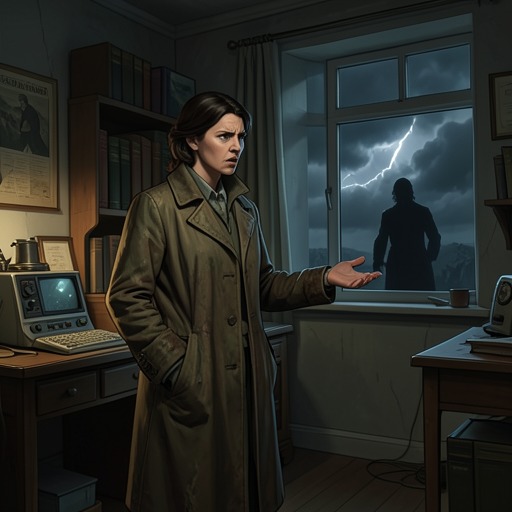
Elvy Lundberg
Handling the UndeadElvy Lundberg’s belief that the dead have returned as part of the Resurrection is inseparable from her sensitivity to what others cannot perceive. Her own experiences have taught her how easily such sensitivity can be dismissed as illness; when the crisis gives it a religious meaning, however, she understands it as both a gift and a responsibility. The return of her husband Tore confronts her with a more private truth: love and duty do not erase the limits of what she can bear.
Identity and Background
Elvy is an older woman whose life has been shaped by emotional sensitivity, Christian faith, and a sense of kinship with her granddaughter Flora. She remembers that at Flora’s age she was diagnosed as “hysterical,” a label that carried a particular sting in the 1950s, when the welfare state was flourishing and rationality seemed close to triumph. Elvy had cut her arms and legs, her bodily injuries giving outward form to inner pain and outside pressures. In the world around her, unhappiness itself seemed to have no legitimate place.
The language applied to Flora is different but not necessarily more understanding: her school counsellor describes her as having self-destructive tendencies. Elvy does not know whether that diagnosis is better or worse than her own. The shift in terminology marks a change in the era, but leaves the two women connected by an experience that conventional explanations struggle to contain. Elvy senses that connection from the time Flora is very young, recognizing in her a seriousness and imagination that might bring trouble as well as insight.
Elvy sees this sensitivity as having skipped a generation. Flora’s mother, Margareta, responded to her own emotional upbringing by studying law and becoming polished, orderly, and successful; she married Goran, another law student. Against that composed family background, Elvy and Flora share a less easily managed way of registering the world. Their affinity is not simply temperamental: they share what they call the Sense.
The Sense and Her Bond with Flora
The Sense is difficult to define because it arrives less like a thought than an impression of scent. Elvy and Flora can discern something lingering around people and places, much as a fox can detect a hare in the dark and sense, from the hare’s fear, that it knows it is being hunted. Elvy has occasionally encountered other people with the ability, but in Flora’s experience Elvy is the only other person who shares it. When the two first spoke about it a couple of years earlier, the recognition brought relief: neither had to be alone in what others might regard as madness.
Elvy knows how precarious that recognition is. In another society or another age, she thinks, people like them might have been shamans—or burned at the stake. In contemporary Sweden, their sensitivity can instead be called hysteria, self-destruction, or excessive emotion. That contrast helps explain why the Sense matters so deeply to their relationship: it gives them a shared means of acknowledging experiences that ordinary language and social judgment tend to discount.
Their intimacy also appears in everyday scenes. At home, Elvy asks Flora to turn off a video game because its groaning sounds worsen her headache. Flora agrees, saves her progress, and turns it off; Elvy, who has been unable to concentrate on her history book since the headache began, watches her return to the game’s safe room before asking about it. The small exchange shows care without ceremony. Elvy notices Flora’s distress, while Flora makes room for Elvy’s discomfort; their closeness is woven into ordinary domestic habits as well as their shared perceptions.
Tore’s Return and the Limits of Duty
When Tore appears at the door after his death, Elvy meets a familiar person made startlingly strange. He wears his best suit, but it hangs loosely after the twenty kilograms he lost during his final illness. His arms dangle, and his bare white feet, with untrimmed toenails, draw her attention as she backs away and catches herself against the coat rack. The scene makes his return bodily and immediate: this is not an idea about death, but the dead husband standing on her front step.
Elvy’s first response includes fear and hostility. As she wrestles with what has happened, she blames Tore for the burden now placed on her and wonders whether she has not already done enough. Then a theological technicality offers a way to set down that responsibility. She recalls the marriage vow, “For better or for worse, until death us do part?” Tore is dead, she reasons, and her promise to the priest forty-three years earlier did not require her to have, hold, or cherish him afterward. The thought makes her smile despite the situation and gives her a boundary where she had been feeling trapped by obligation.
Her boundary is not a denial that Tore mattered. Elvy remembers that he took a woman regarded as hysterical into marriage, cared for her, and guided her through life, even though he never understood her. She bears little animosity toward him and believes he did the best he could. She had already had ample time to enjoy his company while he was alive; by the time he died, she had seen enough. Her response holds affection, gratitude, fatigue, and refusal together rather than reducing their marriage to either devotion or resentment.
Faith and the Mission
Elvy’s religious interpretation of the crisis grows more certain as she tries to understand the dead’s presence. She tells Flora that the spirits—the souls of the dead—have been let out. When she grasps that the event could be the Resurrection, she is overcome by joy and anticipation. She calls it “The raising of the dead” and insists that nothing else could explain what is happening. Yet the intensity is difficult to communicate: rather than discuss it, she asks to sit undisturbed with what she has realized.
That conviction becomes a calling when Elvy sees the Virgin Mary appear on the television. The screen has turned on while Elvy sleeps, its light so intense that she must squint. At its centre she recognizes a woman in a dark blue shawl, her black hair framing a face marked by the grief of a mother who has seen her child die. Elvy understands the image as a vision of tribulation: not only the pain of a mother losing her child, but the anguish of living in a world where such suffering can happen.
The Virgin Mary knows Elvy’s name and tells her that a task awaits. The instruction is direct: the dead must come to her, and Elvy must make them understand that this is their only salvation. The vision turns her private faith into a public obligation. Elvy is not merely interpreting events for herself; she is being asked to persuade others, including the returned dead, to seek the refuge she believes the Virgin Mary offers.
Change and Narrative Significance
Elvy’s religious confidence does not make her life simple or free of anger. After becoming upset by a television broadcast, she paces through the house, takes the copied psalms from the guest room, crumples them, and throws them away. The pages are spotted with Tore’s fluids, so the act carries the physical aftermath of his return as well as her response to what she has heard. She then calls Hagar, her closest church companion. For twelve years they and Agnes have prepared coffee for Saturday meetings and taken turns making cake; as Agnes has become less active, Elvy and Hagar have kept the gatherings going chiefly between them for the last three years. Faith, for Elvy, is sustained through these practical acts of fellowship as well as visions and doctrine.
The story sets these forms of faith beside Elvy’s personal limits. She does not respond to Tore’s return with limitless tenderness, nor does her experience of the supernatural make her immune to the labels that have followed her sensitivity. Instead, the Sense first offers recognition between grandmother and granddaughter, then the crisis gives Elvy a framework in which her perceptions can become a mission. Her arc turns on that change of scale: what once isolated her as an allegedly hysterical woman becomes, in her eyes, a way to hear and answer a summons. The responsibility she accepts is real, but so is the boundary she draws around the dead husband she has already spent a lifetime caring for.